Space took a giant leap closer to earth today, following the launch of a new joint venture between Rocket Racing, Inc. (RRI), Armadillo Aerospace and the government of New Mexico. With a goal of sending adventurers into suborbital space with a target price of $100,000 per ticket or less, the three companies unveiled plans to field a fleet of reusable Vertical Take-Off and Landing (VTOL) vehicles (RLV) that will take flight from Spaceport America near Las Cruces, New Mexico. Each ship is slated to provide a cabin where passengers can float weightless with a 360-degree view of space. To date, other companies in the commercial space industry have promised rides to similar altitudes featuring small porthole-sized views for more than $200,000.
"I am honored that Rocket Racing, Inc. and Armadillo Aerospace have chosen New Mexico to set up shop," said Governor Bill Richardson. "Spaceport America and the State of New Mexico are proud partners and together we are writing the next chapter of space transportation."
Under the terms of the partnership, Armadillo Aerospace will develop the reusable launch vehicles and provide ground support and equipment. The State of New Mexico will supply launch facility infrastructure and resources. Rocket Racing Technology Development, a wholly owned subsidiary of Rocket Racing Inc., will provide financing for, and business and operational management of, the partnership. Reservations, experience marketing, customer training and the coordination of the passengers' overall experience will be managed exclusively by a third partner company that will be announced when marketing efforts begin.
"The price of space is coming down to earth," said Granger Whitelaw, Chief Executive Officer of Rocket Racing, Inc. "And thanks to Armadillo's ships and New Mexico's spaceport, human beings will be treated to the most stellar views in the galaxy."
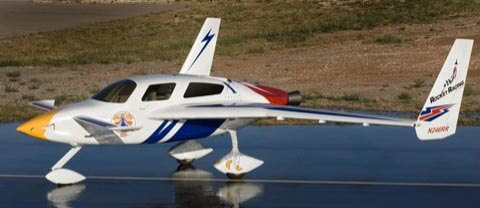
While the venture owes its wings to technologies that have spent decades in development, its launch is made possible only through their recent combination. Armadillo's eight years of research and development on a dozen different flying vehicles is contributing engines, software, and operational capabilities. Meanwhile, the company's ground and flight test programs for the Rocket Racing League over the past year has resulted in flight research data that will be applied to allow for superior vehicle tracking and passenger safety.
Beyond suborbital space tourism, Rocket Racing Inc. also plans to deploy its vehicles to serve in a variety of payload transport initiatives. Target missions include micro-gravity experiments, astrophysics observations, reconnaissance and high-altitude scientific and meteorological measurements.
The companies plan to fly evolutions of existing vehicles to space and fabricate an initial manned vehicle prototype in 2009 and perform initial manned flights to space in 2010. This is great news, and provides an alternative to the more expensive space travel business run by Virgin Galactic, also based at Spaceport America in New Mexico.
You should follow me on twitter here.